When I was young, I had a rather simple understanding of what it meant to obey God.
I was raised Catholic, and like many children, I understood obedience primarily through rules. There were commandments to follow, sins to avoid, prayers to recite, and religious obligations to fulfill. If I did what I was supposed to do, I was being a good Catholic. At least, that was how I understood it.
Obedience was something expected of me. It wasn’t necessarily something I embraced.
As I grew older, I carried much of that understanding into adulthood. I believed in God, certainly, but when it came to making decisions, solving problems, and determining the direction of my life, I generally relied upon myself.
I worked hard. I made plans. I pursued what I believed would make me happy. When difficulties arose, I did what I could to overcome them. When things went wrong, I tried harder.
I rarely stopped to ask whether what I wanted was what God wanted for me.
Looking back, I realize that I wasn’t necessarily rejecting God’s will. More often, I simply wasn’t considering it.
There is a difference.
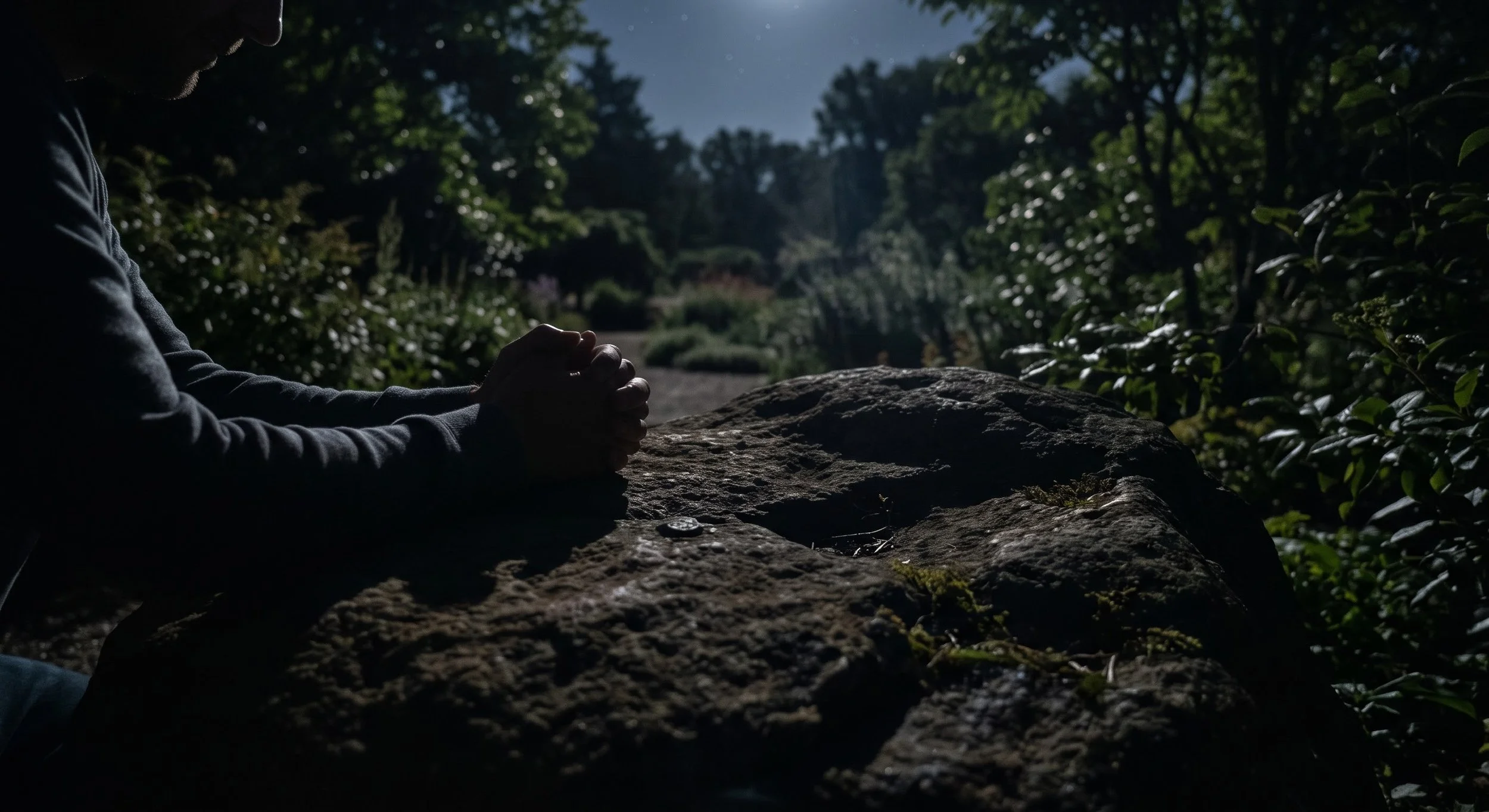
The Garden of Gethsemane
One of the most profound moments in Scripture, at least for me today, is found in the Gospel of Luke.
Jesus, knowing the suffering and death awaiting Him, withdraws to pray on the Mount of Olives.
He says:
“Father, if thou art willing, remove this cup from me; nevertheless not my will, but thine, be done.” — Luke 22:42 (RSV-CE)
I’ve heard those words throughout my life. But I don’t believe I fully appreciated their meaning until much later.
Jesus was not simply demonstrating obedience to a commandment. He was demonstrating perfect surrender.
As Catholics, we believe Jesus is fully God and fully man. He possesses both a divine will and a human will. In Gethsemane, His genuine human anguish reveals the terrible suffering He is about to endure. Yet His human will remains perfectly obedient to the Father’s divine will.
He knew what was coming.
He knew the physical suffering, the humiliation, the betrayal, and ultimately, the Cross.
And still, He submitted Himself to the Father’s will.
What strikes me most today is that His obedience was not dependent upon the absence of suffering.
He did not say He would obey only if the path were made easier.
He entrusted Himself completely to the Father.
And suddenly, the words follow Me take on a meaning far beyond what I understood as a child.
Obedience Is More Than Following Rules
For much of my life, I believed that being obedient to God meant avoiding wrongdoing and trying to be a decent person.
Those things certainly matter. The commandments are not optional, and the Church’s moral teachings exist for good reason.
But I’ve come to understand that obedience also involves something much more personal.
It requires examining my intentions.
It requires asking whether my decisions are motivated by pride, fear, selfishness, impatience, or genuine love of God.
And perhaps most difficult of all, it requires accepting that God’s will may not always resemble the life I would have chosen for myself.
That is where I struggle.
I have spent decades learning how to be self-reliant. I learned early in life to solve my own problems, endure my own difficulties, and depend upon my own efforts.
There was a certain comfort in believing that I controlled the outcome of my circumstances.
But surrendering to God requires me to loosen that grip.
It means acknowledging that my understanding is limited, my judgment is imperfect, and my plans, however carefully considered, may not serve my ultimate good.
Obedience is no longer simply about doing what God commands. It is about learning to want what God wants.
And I am still learning.
When God’s Will Is Not My Preference
It’s easy to speak about surrender when life is going well.
It’s considerably more difficult when prayers seem unanswered, circumstances remain unchanged, or the future looks nothing like what we had imagined.
I sometimes find myself asking God for guidance while quietly hoping His answer will agree with my own expectations.
I ask for patience, but I want resolution.
I ask for wisdom, but I want certainty.
I ask Him to direct my life, but I still occasionally reach for the steering wheel.
There is something almost comical about that contradiction, although I suspect I’m hardly alone in it.
The older I become, the more clearly I recognize how often my desire for control disguises itself as responsibility.
I tell myself I’m simply being proactive. That I’m doing what needs to be done. That God expects me to make an effort.
And He does expect us to act responsibly.
But there is a difference between cooperating with God’s grace and insisting upon my preferred outcome.
Surrender does not mean becoming passive, abandoning responsibility, or refusing to make decisions. It means doing what is right while entrusting the outcome to Him.
That distinction has taken me a long time to appreciate… and I still experience impatience.
The Cross Changes Everything
In Luke 9:23, Jesus tells His followers:
“If any man would come after me, let him deny himself and take up his cross daily and follow me.”
As a younger man, I understood taking up my cross primarily as enduring life’s hardships.
Today, I recognize another dimension.
Sometimes the cross I must carry is my own stubbornness.
My pride.
My impatience.
My reluctance to accept an answer I don’t particularly want to hear.
Sometimes denying myself means surrendering a desire that isn’t sinful in itself, but may not be what God is asking of me at this particular moment.
And sometimes obedience simply means remaining faithful when I cannot understand why God has permitted a particular season of my life.
Jesus did not promise that following Him would eliminate suffering.
He demonstrated that obedience and suffering can exist together, and that suffering endured in union with Him need not be meaningless.
I find that both humbling and reassuring.
Learning to Say Yes
There was a time when I viewed obedience as a restriction upon my freedom.
Now I increasingly see it as a path toward genuine freedom.
Freedom from the exhausting belief that everything depends upon me.
Freedom from the constant need to control circumstances.
Freedom from believing that my happiness must come from achieving the life I have imagined for myself.
I still have responsibilities. I still make plans. I still work toward goals.
But I am learning to hold those plans a little less tightly.
I am learning that God’s will is not something to fear simply because it may require sacrifice.
And I am learning that trusting Him does not require understanding everything He permits.
That may be the greatest difference between the Catholic I was and the Catholic I am trying to become.
As a child, I obeyed because I was told to.
As a young adult, I often obeyed when it was convenient.
Today, I want to obey because I love Him.
Not perfectly. Not without hesitation. And certainly not without occasionally struggling against my own preferences.
But willingly.
Because when I look upon Christ in Gethsemane, I see that obedience is not merely a religious obligation.
It is an act of love.
And perhaps the greatest act of faith I can offer God is not another promise that I will do better, work harder, or accomplish more.
Perhaps it is simply to kneel before Him and sincerely say:
Father, I have spent much of my life asking You to bless my plans. Teach me instead to embrace Yours.
Not my will, but Yours be done.
Amen.
