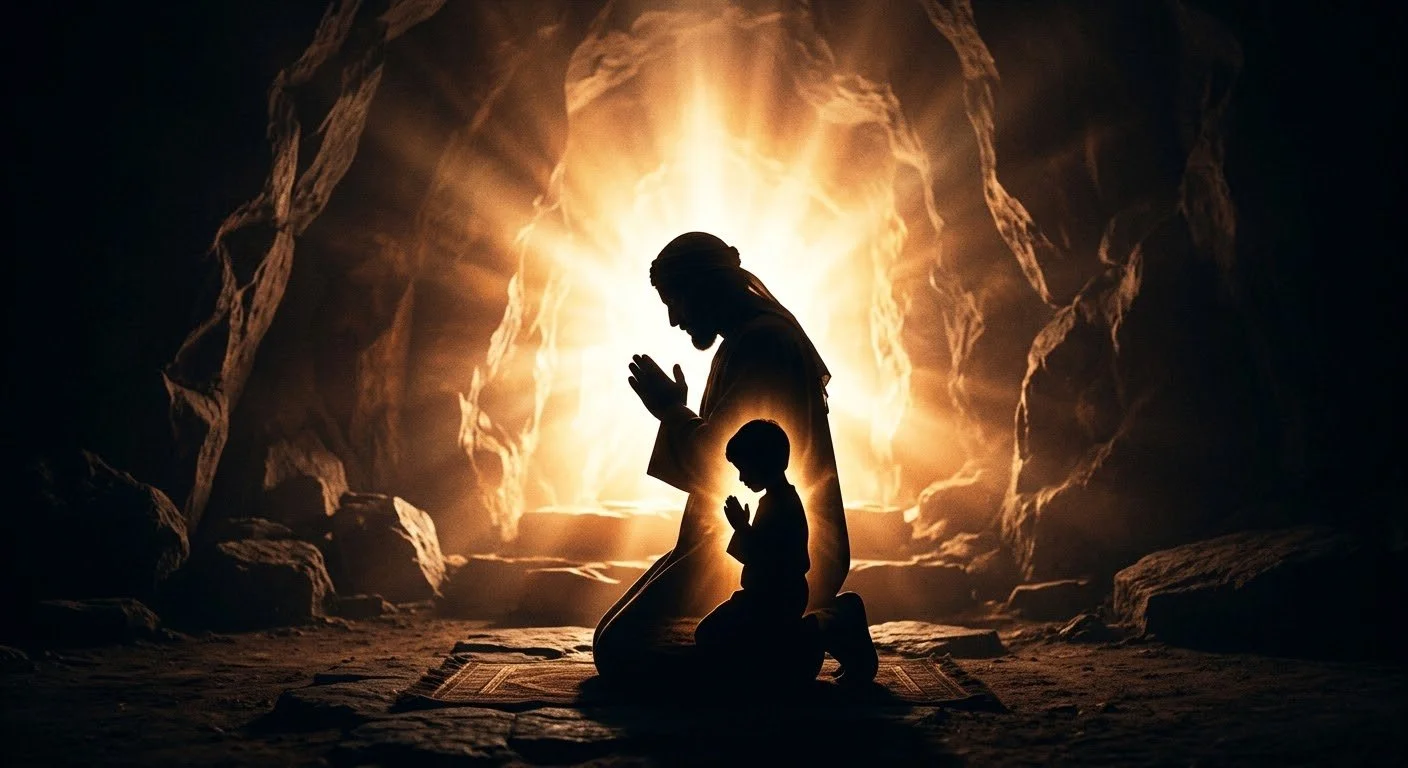
When I was a child, prayer was something I was told to do.
I learned the words. I memorized them. I knew when to say them and, like most children, I knew how to get through them as quickly as possible.
Our Father, who art in Heaven…
Hail Mary, full of grace…
I could say the words correctly. I could say them from memory. And once I reached the end, I felt a small sense of accomplishment.
Done.
Looking back, I think that was the problem. My goal wasn’t really prayer. My goal was the completion of prayer.
There is a difference.
I don’t say this to diminish the prayers the Church taught me. Quite the opposite. I now understand their beauty far more than I ever did then. The Our Father, the Hail Mary, the Rosary… these weren’t empty prayers.
I was the one who was often empty while saying them.
When Prayer Became More Serious, but Still Felt Empty
As I grew older, my prayers matured somewhat.
I said them with a little more seriousness. I slowed down occasionally. I might add a few personal words at the end for good measure.
Maybe a request.
Maybe a complaint.
Maybe something I desperately wanted God to fix.
But if I am being truthful, much of my prayer life still revolved around me.
Why am I unhappy?
Why isn’t this working?
Why don’t I have what I want?
When will things get better?
I prayed about my circumstances, my disappointments, my loneliness, my problems and the things I thought would finally make me happy.
Even when I prayed the Rosary, there were times when finishing it seemed more important than actually being present within it.
Fifty Hail Marys. Five decades.
Done.
Somehow, I thought completing the prayer was the accomplishment.
It took me many years to understand that God wasn’t waiting for me to impress Him with my ability to finish.
He wanted me.
Somewhere Along the Way, I Stopped Reciting and Started Talking
My prayer life today feels almost unrecognizable compared with the prayer life of my youth.
I still pray the traditional prayers of the Church. In fact, they mean more to me now than they ever have.
But something changed.
I started speaking to God.
Not performing.
Not checking something off a spiritual list.
Speaking.
I finally began to understand something extraordinarily simple: God already knows me completely. He knows what I am thinking before I manage to put it into words. He knows where I am being sincere, where I am afraid, where I am prideful and where I am still holding something back.
So why pretend?
Why manufacture some polished version of myself for the One who already knows every corner of my heart?
Jesus tells us:
“Your Father knows what you need before you ask him.”
— Matthew 6:8
That changed the way I approached prayer.
I could speak plainly.
Respectfully, certainly. Reverently, absolutely.
But honestly.
My Conversations During Adoration
This has become especially real to me during Eucharistic Adoration.
There are moments when I simply sit before Jesus and talk.
Sometimes I have questions.
Sometimes I have regrets.
Sometimes I ask for mercy.
Sometimes I tell Him that I am struggling to understand what He is doing in my life.
And sometimes I have to admit:
“Lord, I know I am supposed to surrender this to You. I also know that I’m not very good at surrendering. Please help me surrender.”
There is something liberating about that kind of honesty.
I don’t have to pretend that I have reached some advanced level of spiritual maturity.
I haven’t.
In many ways, I am still a child looking for answers.
The difference is that now I know where to bring the questions.
The Questions Changed Too
My prayers as a younger man were often concerned with happiness.
My prayers now are much more concerned with holiness.
That doesn’t mean I don’t bring my earthly problems to God. I certainly do. Adulthood brings problems that are far more complicated than the ones I complained about when I was young.
But the questions themselves have changed.
Instead of only asking, “God, why isn’t my life the way I want it?”
I am learning to ask:
“God, what are You trying to teach me here?”
“What do I need to let go of?”
“Where is my pride getting in the way?”
“Who needs my prayers more than I need something for myself?”
“How can I use whatever gifts You gave me to glorify You?”
And perhaps the hardest:
“How do I accept Your will when Your will isn’t what I wanted?”
That last one remains difficult for me.
I have spent most of my life solving problems through effort. Work harder. Think harder. Endure longer. Find another solution.
Surrender does not come naturally to someone accustomed to relying upon himself.
So now I even pray about my inability to pray as I should.
I ask God to help me trust God.
Prayer Became Less About What I Wanted
One of the greatest changes I’ve noticed is how much more often other people enter my prayers.
There was a time when prayer was largely a list of things I wanted changed in my own life.
Now I find myself praying for people who are suffering. For people who have lost their faith. For souls in need of mercy. For people I love. For people I struggle to understand. For the ability to help someone else.
I also pray that whatever abilities God has given me might actually be used for His purposes rather than merely for my own validation.
That is quite a change from the younger version of myself.
Back then I wanted God to bless my plans.
Now I’m trying to learn how to ask God what His plans are for me.
I’m still learning.
“Lord, Teach Us to Pray”
There is something comforting about the fact that even the disciples asked Jesus:
“Lord, teach us to pray.”
— Luke 11:1
They walked beside Him and still needed to be taught.
So perhaps learning how to pray isn’t something we finish in childhood.
Perhaps we spend our entire lives learning.
The prayers I memorized as a child weren’t the problem. They gave me a foundation I didn’t appreciate at the time. Today I can pray the Our Father or the Rosary and understand that the words aren’t merely something to get through.
They are supposed to draw me somewhere.
Toward contemplation.
Toward humility.
Toward repentance.
Toward Christ.
The difference is that now I try to actually be there while I’m saying them.
I Finally Understand Why I Am Praying
I used to think prayer was something a good Catholic was supposed to do.
Now I understand prayer as something I need.
There are days when I need to speak.
There are days when I need to listen.
There are days when I need to sit quietly before the Blessed Sacrament and admit that I have absolutely no idea what God is doing.
And there are days when the only honest prayer I have is:
“Jesus, help me.”
I’m beginning to believe that a few sincere words offered from the heart can contain more of me than a thousand words spoken merely because I feel obligated to finish them.
At nearly sixty, I find myself approaching God differently than I did as a child.
Ironically, I approach Him more like a child now than I did then.
Not childish.
Childlike.
I don’t have all the answers anymore and I no longer feel the need to pretend that I do.
I simply come before my Father with what I have.
My gratitude.
My sins.
My questions.
My fears.
My stubbornness.
My concern for others.
My desire to serve Him.
And my continuing difficulty surrendering everything completely.
Maybe that is the greatest change in my prayer life.
When I was young, I prayed because I had been taught the words.
Later, I prayed because I thought I was supposed to.
Now I pray because I finally understand Who is listening.
