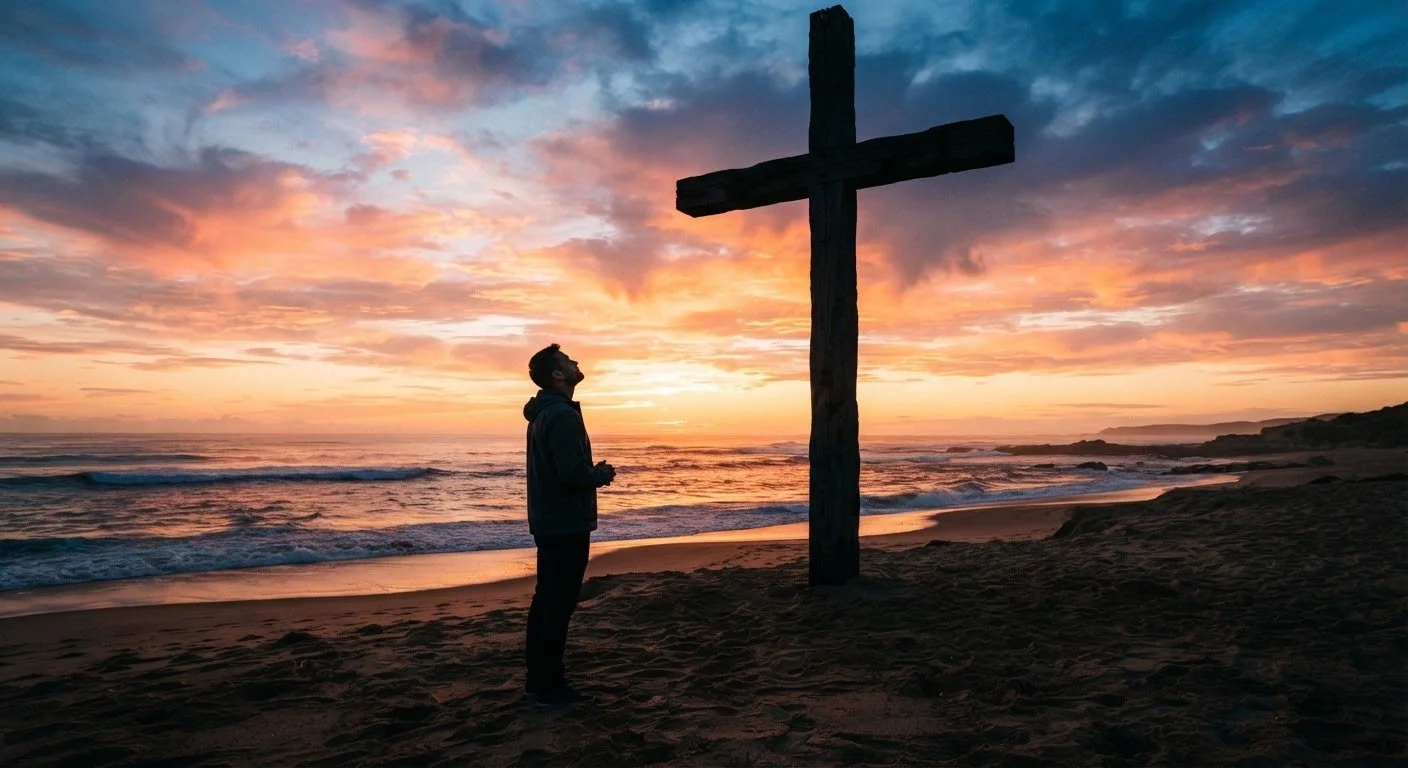
“If anyone wishes to come after me, he must deny himself and take up his cross daily and follow me.”
— Luke 9:23
I have heard those words for most of my life.
Take up your cross and follow Me.
Like so many passages of Scripture I heard when I was younger, I understood the words without really understanding what they demanded. “Carrying your cross” became almost interchangeable with enduring something unpleasant. A difficult job. A strained relationship or its after effects. An illness. A financial problem. We even use the expression casually: Well, I suppose that’s my cross to bear.
But when Jesus spoke those words, the cross was anything but a casual metaphor.
To the people listening to Him, a man carrying a cross was going somewhere very specific.
He was going to die.
A condemned man could be forced to carry the instrument of his execution toward the place where his life would be taken from him. There was nothing sentimental about the image. There was humiliation, suffering and death.
And yet Jesus tells His followers to take up their cross daily.
He was revealing something much deeper than simply accepting life’s inconveniences.
He was asking us to die to ourselves.
The Cross I Didn’t Know I Was Avoiding
For most of my life, self-reliance was something I considered a virtue.
If I wanted something, I worked for it.
If my health needed attention, I tended to it.
If I was hurting emotionally, I endured it until eventually I could see some light again.
If there was a problem, I tried to solve it.
There is certainly nothing wrong with responsibility, discipline or perseverance. God does not ask us to become passive spectators in our own lives. But somewhere along the way, responsibility can quietly become something else.
It can become the belief that everything ultimately depends upon me.
Looking back, I can see how deeply that idea became embedded in me.
Perhaps even more tragically, I sometimes thought bringing every concern to God would somehow amount to bothering Him.
Surely God had more important things to deal with.
So I carried things myself.
And carried them.
And carried them.
Ironically, I was willing to carry almost everything except the cross Christ was actually asking me to carry.
Because His cross required something much more difficult for me:
Letting go.
Deny Yourself
Jesus doesn’t begin Luke 9:23 with the cross. He begins with something that makes carrying it possible:
“He must deny himself.”
That doesn’t mean despising ourselves. It doesn’t mean pretending we have no needs, personality, desires or responsibilities.
It means that I am no longer the center.
My plans are not ultimate.
My understanding is not ultimate.
My accomplishments do not define my worth before God.
Neither do my failures.
That last part has become increasingly important to me.
I can spend far too much time keeping a running tally of myself.
What did I do right today?
Where did I fail?
Am I becoming holier?
Am I disappointing God?
Am I doing enough?
Am I praying enough?
Am I progressing quickly enough?
Even our desire to become better Christians can become strangely centered on ourselves if we aren’t careful.
Eventually, I have to look away from the scoreboard and look toward Christ.
Because Christianity isn’t ultimately the story of what I accomplish for God.
It is the story of what God accomplishes in me when I finally allow Him to. That changes the narrative completely.
Surrender Does Not Mean Doing Nothing
This is where surrender has always been difficult for me.
There is a part of me that still wants instructions, measurable progress and evidence that everything is moving in the right direction.
Work harder. Fix the problem. Find the answer. Move forward.
Surrender feels different.
Sometimes surrender means acting.
Sometimes it means waiting.
Sometimes it means accepting that I cannot presently understand what God is doing.
And sometimes it means continuing to pray when prayer feels dry and God seems painfully quiet.
That may be one of the heavier crosses.
It is relatively easy to trust God when I can see where He is leading me. It is something altogether different to trust Him when the road disappears into darkness.
Jesus Himself prayed in Gethsemane:
“Father, if you are willing, take this cup away from me; still, not my will but yours be done.”
— Luke 22:42
That is genuine surrender.
Christ did not pretend the cup wasn’t painful. He did not call suffering pleasant. He expressed His anguish to the Father…and then entrusted Himself completely to the Father’s will.
Perhaps that is something I am still learning.
Surrender doesn’t mean that I stop feeling afraid.
It means fear doesn’t get the final word.
Surrender doesn’t mean I stop working.
It means I stop believing that my work alone controls the outcome.
Surrender doesn’t mean every hardship is something God directly caused.
It means that nothing I endure is beyond His ability to redeem.
And surrender doesn’t mean I understand God’s plan.
It means I trust God even when I don’t.
“Daily”
There is one word in Luke’s Gospel that I find especially important:
Daily.
Jesus says to take up our cross daily.
Apparently, yesterday’s surrender isn’t enough for today.
I understand why.
I can surrender something to God in prayer and, remarkably, take it back before lunchtime.
I can tell Him, Your will be done, and several hours later find myself mentally rearranging circumstances to make sure His will resembles mine.
Maybe that is why surrender is not a single heroic moment.
It is a habit.
A daily death to the illusion of control.
A daily decision to say:
Lord, this belongs to You.
My future belongs to You.
My health belongs to You.
My work belongs to You.
My loneliness belongs to You.
My successes belong to You.
My failures belong to You.
Even the things about myself that I am desperately trying to repair belong to You.
I will still work. I will still make decisions. I will still take responsibility for the life You have given me.
But I no longer want to confuse responsibility with sovereignty.
You are God. I am not.
There is tremendous freedom hidden inside those five words.
Perhaps This Is the Cross
For someone who spent much of his life depending upon himself, perhaps surrender itself is part of my cross.
Not because God wants to strip away my strength, but because He wants me to understand where strength ultimately comes from.
St. Paul learned something similar when he begged God to remove his own mysterious “thorn.” Instead, the Lord told him:
“My grace is sufficient for you, for power is made perfect in weakness.”
— 2 Corinthians 12:9
Those words would have frustrated the younger version of me.
Don’t tell me grace is sufficient. Tell me how to fix it.
Now I am beginning to understand.
There will be seasons when the cross becomes lighter.
There will be seasons when it becomes heavier.
There may be times of consolation when God’s presence seems unmistakable, and periods of spiritual dryness when I wonder why He seems so distant.
But perhaps the question isn’t always:
Why hasn’t God removed this yet?
Perhaps sometimes the better question is:
What is God teaching me while I carry it?
I don’t believe God is asking me to stop caring about the outcome of my life. I think He is asking me to stop worshipping the outcome.
That means I cannot measure God’s goodness by whether today went according to my plans.
I cannot measure His love by how comfortable my life feels.
And I cannot measure my relationship with Him by a running tally of successes and failures.
The cross destroys that illusion.
It reminds me that this life was never supposed to revolve around me.
Follow Me
There is something else I overlooked for years.
Jesus doesn’t merely say, Take up your cross.
He says:
“Take up your cross daily and follow me.”
The cross has a destination.
Christ is leading.
That changes everything.
I don’t have to know the entire road. I don’t have to understand every hardship. I don’t have to predict what comes next. I don’t even have to feel God’s presence every moment in order to continue walking toward Him.
I only have to keep following.
After spending so many years believing that I had to carry myself through life, I am slowly learning something that should have been obvious all along:
I cannot.
And strangely, admitting that has not made me feel weaker.
It has made me feel freer.
Because almost everything I spent my life trying to control was never completely within my control in the first place.
My responsibility is to work, pray, repent, love, persevere and remain faithful.
The rest belongs to God.
Maybe taking up my cross begins every morning with something as simple as this:
Lord, today I will do what You ask of me.
I will carry what You permit me to carry.
I will change what You give me the ability to change.
And what I cannot carry alone, I give completely to You.
Not my will, but Yours be done.
And then tomorrow morning?
I will probably have to surrender it all over again.
