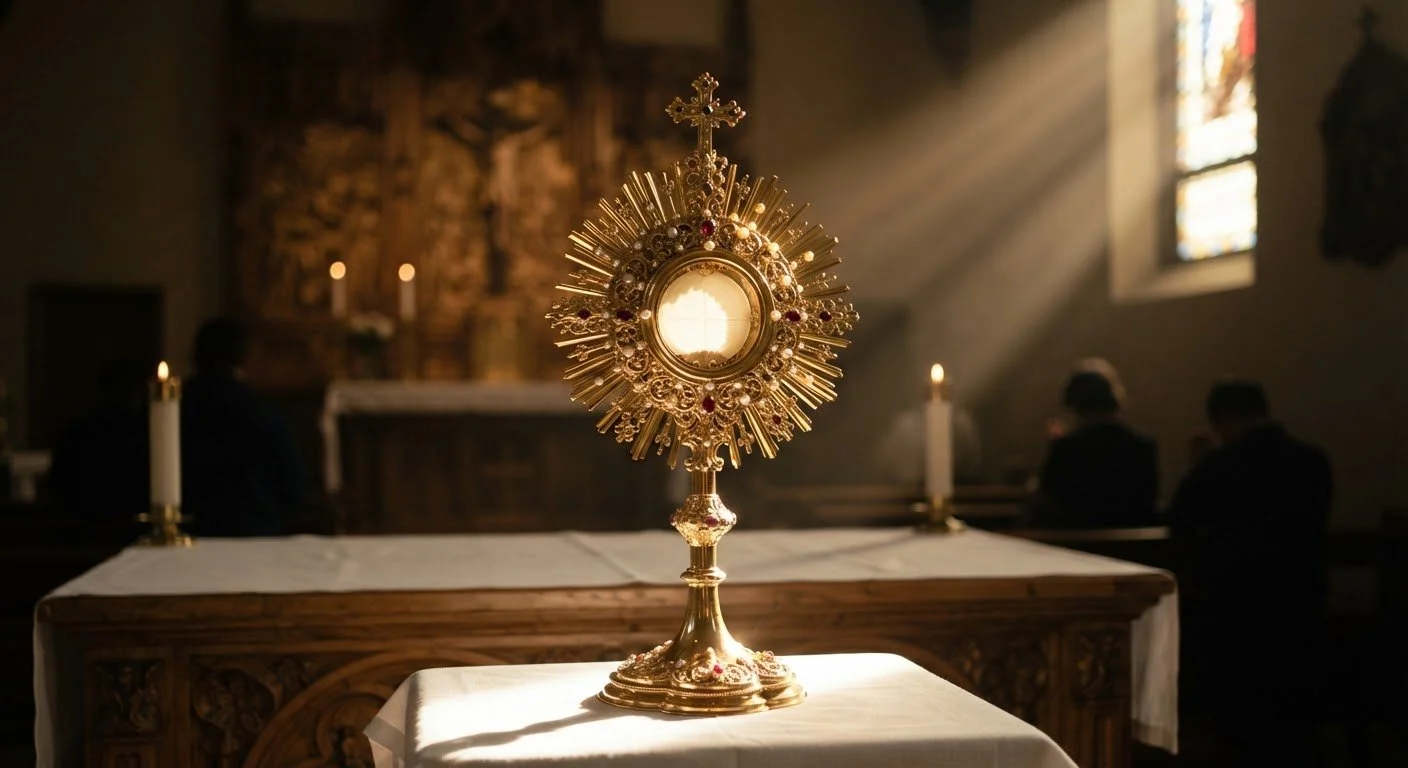
When I was young, I understood Holy Communion in the simplest possible terms.
It was a wafer.
Of course, I knew what I had been taught. I knew it represented Jesus. I knew the Last Supper. I knew about His sacrifice on the Cross. I knew when to stand, when to kneel, when to walk forward, and when to say “Amen.”
But knowing the motions of something is very different from understanding the mystery of it.
As a teenager, Communion felt more like a ceremony commemorating what Jesus had done for us. The bread signified His Body. The wine signified His Blood. At least, that was how my young mind processed it.
I don’t think I fully grasped what the Catholic Church was actually asking me to believe.
That it was Him.
Not merely a reminder of Him.
Not simply a symbol of His sacrifice.
Not something intended only to make me think about the Last Supper.
Jesus Christ…Body, Blood, Soul and Divinity…truly present in the Holy Eucharist.
The Church calls this transubstantiation. The appearances of bread and wine remain, but their substance has become the Body and Blood of Christ.
That distinction means infinitely more to me now than it ever could have when I was young.
Jesus did not say, “This represents my body.”
He said:
“This is my body, which will be given for you; do this in memory of me.”
— Luke 22:19
And in the Gospel of John, Christ says something even more difficult to dismiss:
“Whoever eats my flesh and drinks my blood has eternal life, and I will raise him on the last day.”
— John 6:54
Those words sound very different to me today.
What Was Once a Ceremony Became a Need
There are things about my younger faith that I regret.
I wish I had understood what was happening at the altar.
I wish I had taken my Catholic faith more seriously. I wish I had understood the extraordinary gift that was being placed before me (and eventually placed into my own hands or upon my tongue).
But perhaps one of the stranger gifts of growing older is finally recognizing the value of things we once took for granted.
As a teenager, I could receive Communion and then continue with my day.
Now I find myself needing the Eucharist.
Not because I believe I am entitled to receive Him. Quite the opposite. The more seriously I take the Eucharist, the more seriously I understand the need to prepare myself to receive Him worthily.
Confession matters more.
Examination of conscience matters more.
The state of my soul matters more.
The Eucharist is no longer something that simply happens near the end of Mass.
For me, it has become the center of it.
There is a moment when I watch the priest elevate the consecrated Host, and I realize that everything around me has become secondary.
There is Christ.
The same Christ I pray to when I am frightened.
The same Christ whose forgiveness I seek when I have sinned.
The same Christ I ask for guidance when I don’t know what to do.
The same Christ I have spent so much of my later life trying to grow closer to.
And He is there before me.
And Sometimes, I Just Sit With Him
This understanding has also completely changed the way I experience Eucharistic Adoration.
There is something extraordinarily peaceful about sitting quietly before the Blessed Sacrament.
I don’t always have something profound to say.
Sometimes I pray.
Sometimes I bring Him my worries.
Sometimes my mind wanders.
Sometimes I simply sit there.
But I have come to understand that silence before the Eucharist does not have to be empty.
If Christ is truly present, then I am not sitting alone in a quiet church looking at a consecrated Host.
I am sitting in the presence of Jesus.
That changes everything.
For someone like me, whose mind often moves faster than I would like, there is a particular peace in Adoration. The world can remain outside for a while. The noise, division, responsibilities, worries, temptations and endless demands on our attention can wait.
There is nowhere else I need to be in that moment.
I can simply be with Him.
Perhaps that is one of the greatest differences between the teenager I was and the man I am now.
Back then, I thought faith required me to understand what I was supposed to do.
Now I increasingly understand that sometimes Christ simply asks me to remain with Him.
Today, it’s not uncommon for me to exclaim, “I’ll be back later, I’m gonna hang out with Jesus for a bit!”
What could be greater than that?
If I Could Speak to My Younger Self
I don’t think I would lecture him.
I’m not sure he would listen anyway.
I think I would simply tell him:
Pay attention. Something far greater is happening here than you realize.
When that Host is elevated, look.
When you approach the altar, understand Whom you are approaching.
When you say “Amen,” understand what you are saying Amen to.
You are saying, I believe.
I believe this is Christ.
I believe He gave Himself for me.
I believe He continues to give Himself to His Church.
And I believe that somehow, through a mystery far beyond my ability to completely comprehend, the God who created me allows Himself to become food for me.
There is something profoundly humbling about that.
I Cannot Change the Past
I sometimes regret the years when I did not understand this.
I regret the times I treated Catholicism as something inherited rather than something I had consciously chosen to live.
I regret the years when the Eucharist did not occupy the place in my life that it does now.
But regret can only take us so far.
God has given me today.
And today I understand something my younger self did not.
The Eucharist isn’t merely a reminder of a sacrifice that happened two thousand years ago.
The Eucharist is an encounter with the living Christ.
So now I approach Him differently.
With greater reverence.
With greater gratitude.
And, admittedly, with a greater awareness of how unworthy I am of such a gift.
But perhaps most importantly, I approach Him with love.
What I once saw as a wafer has become something I now recognize as one of the greatest gifts Christ left His Church: Himself.
And after spending so much of my life looking for peace in other places, I find something beautifully simple about where I now find it.
Before the altar.
Before the Blessed Sacrament.
Before Jesus.
I wish I had understood it sooner.
But by the grace of God, I understand it now.
And for however many years He gives me from this point forward, I pray that I never again take His presence for granted.
